A Tea Tin Opened After a Long Pause
A faded aroma may mean a less vivid cup, but smell and appearance cannot establish that tea is safe. Check for warning signs, consider its storage history and discard it when moisture or contamination is possible.
A faded aroma may mean a less vivid cup, but smell and appearance cannot establish that tea is safe. Check for warning signs, consider its storage…
Tea · 6 min read
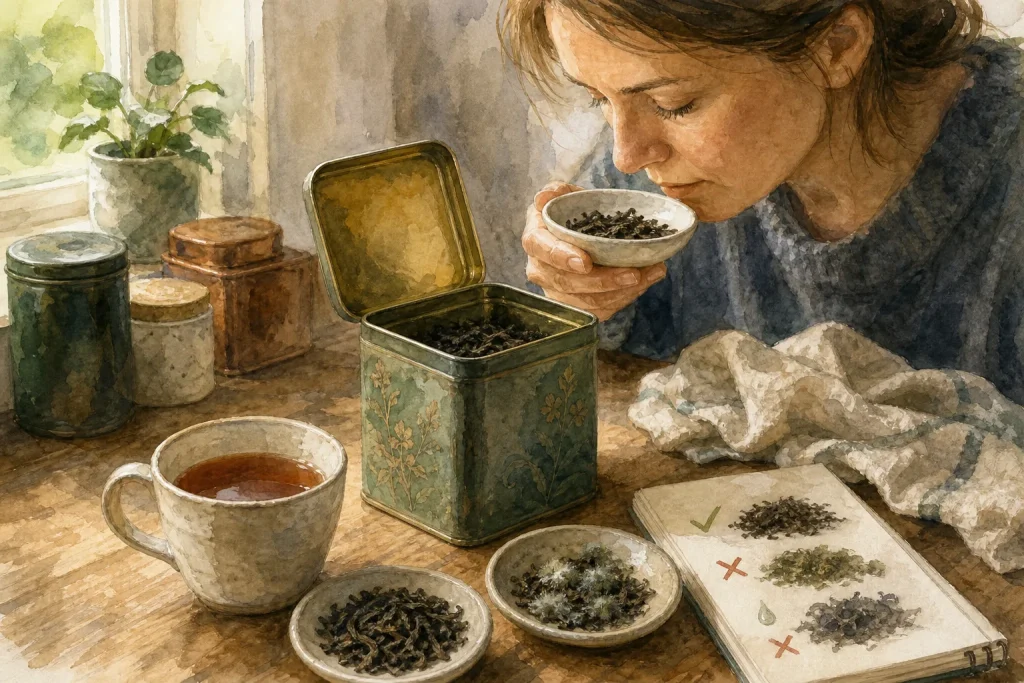
Open a forgotten tea tin and pause before brewing. A faint, familiar tea aroma may point to faded flavour, while dampness, visible growth or a strong foreign smell calls for caution. Smell and appearance are only limited checks: leaves that seem normal are not thereby proven safe, especially if their storage history is uncertain.
Consider the whole picture. Was the tin kept closed in a dry, clean place? Do the leaves look and feel dry, with no visible contamination? Does anything smell persistently musty, sour or chemical? These clues can guide a cautious decision, but none can rule out every problem. If you know water entered the tin, or you cannot make sense of a concerning change, discard the tea rather than tasting it.
Familiar aromas
Tea aromas vary. Green tea may smell grassy or gently nutty; black tea can seem malty, fruity or woody; an oolong may lean floral or toasted. These are broad descriptions, not a safety test. A familiar, muted aroma may suggest the tea has lost some character, but a pleasant smell does not establish that the leaves are safe to consume.
To assess the aroma, tip a little into a clean, odour-free bowl and take a gentle sniff. If the tea is scented with jasmine, citrus peel or spices, compare it with its intended character. A persistent smell of dampness, sourness or cleaning products is a reason to discard it. Do not try to cover a concerning odour with milk, sugar, lemon or a stronger infusion.
Dryness and appearance
Loose tea varies in shape and texture. Rolled oolong can be dense, while broken-leaf black tea is smaller. Look for changes such as clumps, droplets inside the tin, unusual spots or fuzzy growth. These are warning signs, not a complete assessment of safety. If you see mould or other visible contamination, do not taste the tea. Seal the tin, discard its contents and clean and thoroughly dry the container before reusing it.
A dry surface does not prove that the leaves were stored properly or are safe. If you know water entered the tin, it stood open beside a steaming kettle, or condensation formed inside, discard the contents. Do not try to rescue them by drying them at home. If the history is uncertain and the leaves seem damp or have changed, the cautious choice is to let them go.
Age and flavour
Tea can lose aroma and flavour over time. A quiet aroma may lead to a flat cup, but it does not by itself establish whether the tea is safe. A printed date is useful context, not a precise answer about the condition of the leaves. Packaging, storage and the tea itself all affect how its character changes.
A tightly closed tin in a dry cupboard is easier to assess than an unlabelled container found near a sink, but a good storage history still cannot prove safety. If the leaves seem dry and clean and there are no warning signs, you may choose to brew them for taste, understanding that sensory checks have limits. If you are uneasy about their condition, discard them without tasting.
A cautious brew
Only consider a small brew if you have no reason to suspect moisture or contamination. Use a clean infuser, fresh water and the usual brewing guidance for that tea. Tasting is a choice about flavour, not a way to check or make questionable leaves safe. Do not taste tea with visible contamination, a clear off-smell or a known exposure to water.
A mild or flat cup may simply be less enjoyable. A persistently musty, sour or otherwise concerning taste is a reason to stop drinking and discard the tea. Do not add flavourings to disguise it. A harsh cup can also result from brewing choices, so an unpleasant taste alone may not identify the cause; when in doubt, do not continue.
Say you find a tin of plain black tea in a closed cupboard. The leaves look dry, there is no visible growth, and the aroma is faint but familiar; you have no indication that water entered the tin. Those observations do not prove safety. If you judge the storage history credible and choose to brew a small cup, you may find it mild and decide that the flavour is not worth keeping. If you cannot establish whether the tin stayed dry, or notice a musty smell, discard the tea instead of tasting it.
Storage history
Moisture, heat, light and strong smells can affect tea’s condition and flavour. A cool, dry cupboard away from the cooker and sink is a more sensible place than a sunny shelf or a counter beside a kettle. A tightly closing lid helps limit exposure, but it cannot undo earlier moisture or contamination.
Check the container for rust, dirt or a lingering smell from another ingredient. A decorative tin is useful only if it is clean, dry and closes well. If it does not, a clean, dry food container that seals securely may be more suitable. Keep tea away from spices, coffee, soap and cleaning supplies, whose strong aromas may transfer to unsealed leaves.
Keep or discard
- Observation: You see mould, fuzzy growth or other visible contamination. Decision: Do not taste it; discard the tea. If it is only faded in aroma and has no visible warning sign, that alone does not establish a safety problem, though it may be less enjoyable.
- Observation: The leaves feel damp, have clumped unexpectedly or the tin contains droplets. Decision: Discard the tea; do not try to dry it. If the leaves seem dry but you know water entered the tin, discard them anyway.
- Observation: The tea has a persistent musty, sour or chemical smell. Decision: Do not brew or taste it; discard it. If the smell is faint but unfamiliar, avoid tasting until you can resolve the concern; if you cannot, discard it.
- Observation: The storage history is known, the tin stayed closed in a suitable dry place, and there are no visible warning signs. Decision: These details may inform a cautious flavour choice, but they do not prove safety. If you have any reason to suspect contamination, discard the tea instead.
- Observation: The storage history is unknown, especially whether the tea was exposed to water. Decision: Do not use a taste test to settle the uncertainty; discard it. If you can establish that there was no concerning exposure and have no other warning signs, you may still choose whether a brew seems worthwhile, recognising that sensory checks are limited.
- Observation: A small brew from leaves with no known warning signs tastes flat but not concerning. Decision: You may stop using the tea because you dislike the flavour, or keep it for an ordinary cup if you judge that appropriate. If it tastes musty, sour or otherwise concerning, stop drinking and discard it.
For future storage, close the lid after taking out tea, use a dry spoon and return the tin to a clean, dry cupboard away from steam and strong odours. There is no need to transfer every tin if its container is clean, dry and closes securely. Repeatedly opening a tin to check it is not worth the effort: it adds exposure without resolving uncertainty about past storage.